Sculpted SolutionsFlight Systems

Aviation Safety

Real accidents.
Flyable lessons.

We decode official NTSB accident investigations into training missions for Microsoft Flight Simulator 2024. Every mission is generated from a validated reconstruction of a real accident — and teaches the decision that would have survived it.

1982–present

NTSB accident corpus, decoded

2,494

engine-failure-after-takeoff accidents behind mission #1

29%

of those were fatal — the turn back kills

3

render targets from one reconstruction (MSFS 2024, web 3D, FlightGear)

From investigation to cockpit

The same discipline we apply to zoning code and utility corridors, applied to accident data: one validated source of truth, rendered into decisions people can act on.

01

Ingest

The NTSB bulk accident database (1982–present), downloaded, decoded against the official coding manual, and filtered to general aviation.

02

Reconstruct

Each case becomes a validated reconstruction: trajectory, causal chain, and a corrective chain. The validator enforces one rule — the accident path ends at the ground; the corrective path must survive.

03

Classify

A phase-of-flight × human-factors matrix maps where pilots actually die, and a lesson taxonomy sorts every archetype: flyable recovery, decision window, or visual-only briefing.

04

Render

The same reconstruction JSON drives every output — an MSFS 2024 mission built on the SDK, an interactive web 3D replay, a FlightGear scenario. The teaching content can never drift from the investigation.

Watch the reconstruction fly

Rendered frame-by-frame from the validated trajectory by our web 3D engine — the same data that drives the MSFS missions.

The Graveyard Spiral

NTSB ERA19FA181, rebuilt second-by-second. The chase camera follows the reconstruction over wireframe terrain as the unnoticed left bank develops and the spiral tightens — the white line is the flight path from the validated trajectory, the same data that drives the MSFS mission. No dramatization: the path ends where the investigation says it ended.

The reconstruction aircraft

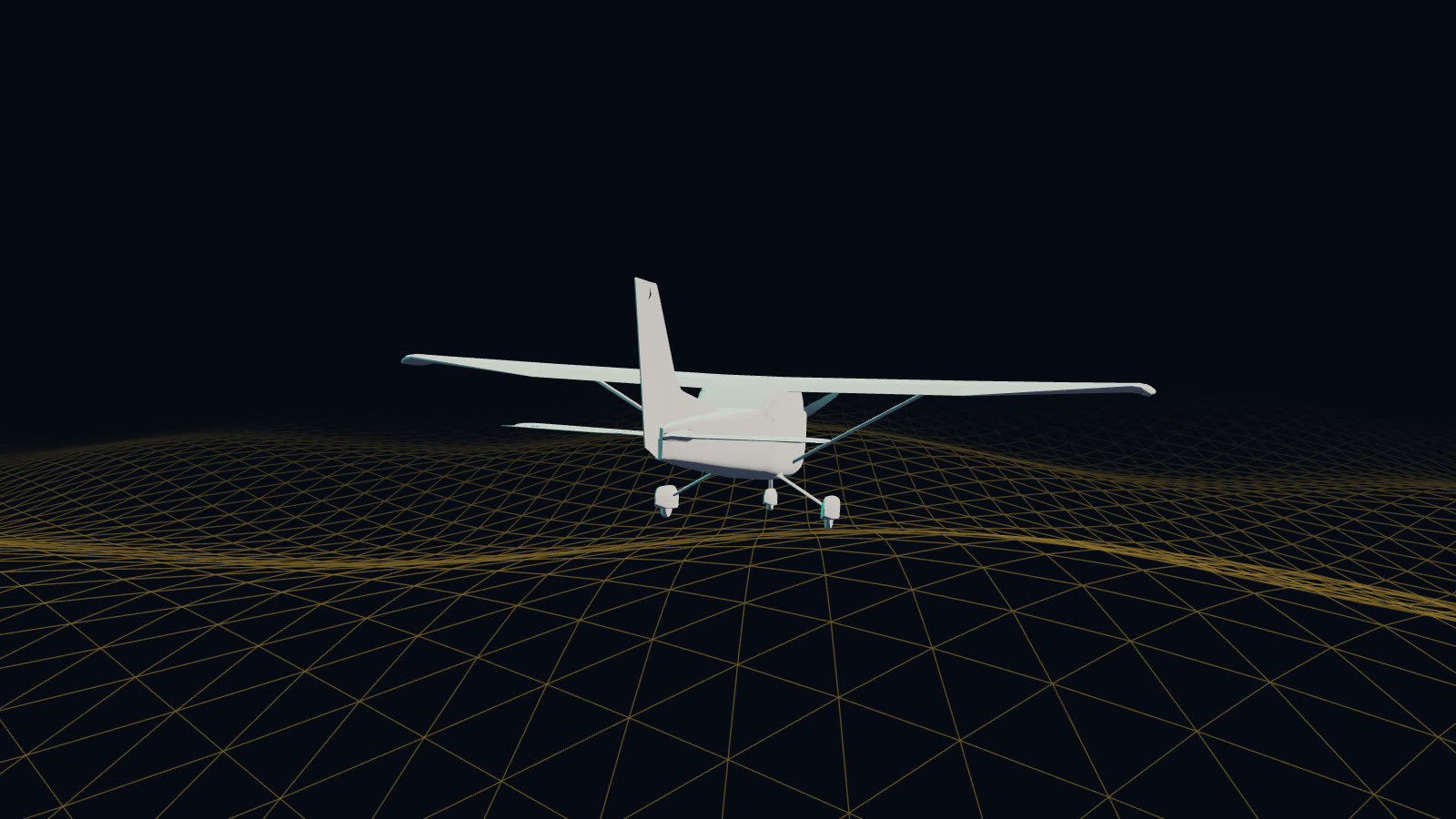
A Cessna 172 in Sculpted Solutions livery — the exact 3D model that flies every trajectory in the engine. Load the interactive view and walk around it: click, hold and drag to orbit. The DHC-2 Beaver joins this hangar when its model completes.

Reconstruction Cessna 172 over gold wireframe terrain

The knowledge base comes first

Before any mission was built, the corpus was evaluated and organized into a learning system: every accident decoded against the official coding manual, classified into typologies — phase of flight, cause category, human factor — and cross-tabulated into a matrix that shows exactly where pilots die. Missions aren't picked because they'd make good content; they're picked because their cell in the matrix earns them.

The accident matrix

Part 91 general aviation, 2008–2026

22,045 accidents · 3,906 fatal · 11 phases of flight × 5 human-factor typologies. A slice by phase of flight:

PhaseAccidentsFatal
Takeoff2,92610%
Climb2,49429%
Cruise3,23528%
Maneuvering2,25244%
Approach2,47626%
Landing7,2862%

Landing wrecks airplanes; maneuvering and the climb-out kill pilots. The matrix is why our first mission is an engine failure after takeoff and not a crosswind landing.

Decoded, not dumped

The raw NTSB database is coded shorthand. Every field is decoded against the official coding manual into human-readable findings, so lessons cite what investigators actually concluded — not a paraphrase.

Typologies, not anecdotes

Five human-factor typologies — skill, decision-making, attention, experience, physiological — crossed with phase of flight. Attention and perception failures are fatal at 35%, nearly twice the rate of pure skill errors.

A design method, not a wishlist

Matrix cell → accident archetype → lesson kind → validated reconstruction → MSFS mission template. Each step is scripted and checked, so the next mission follows the same road as the first.

The honesty filter: what belongs in a simulator

Not every accident should be a mission, and pretending otherwise teaches the wrong thing. Every archetype is triaged by where its survivable path branches:

Flyable recovery

The survivable path branches after the trap springs

Drop the pilot at the recovery point; the sim judges the recovery

Decision window

The survivable path branches before the trap — an ADM choice

Start at the decision point with a closing clock; pressing on plays the unwinnable end

Visual-only

No survivable branch exists in flight

Web 3D replay and briefing — honestly not a mission

The reconstruction validator enforces one rule across everything we ship: the accident path ends at the ground; the corrective path must survive.

Case-study missions

Selected from the matrix, built on the MSFS 2024 SDK, and flown in the sim. Each mission cites its NTSB case; every coaching cue traces to the investigation.

Flown & verifiedNTSB ERA18FA230

The Impossible Turn

Cranland Airport (28M), Hanson, Massachusetts — runway 18 departure, day VMC

Engine failure at 400 feet. Instinct says turn back to the runway. Instinct is wrong — the turn back is how this accident became fatal. The mission fails your engine on climb-out and coaches the decision that survives.

  • Pre-takeoff planning prompt: pick your forced-landing spot before you fly — the honest lesson is planning, not reflexes
  • Annotated satellite briefing map: glide-reach circle, the impossible-turn geometry, and the surfaces worth aiming for
  • Live in-sim triggers: the engine fails passing 400 ft; coaching lines fire on bank angle, stall warning, and outcome
  • Every spoken cue is taken verbatim from the reconstruction of the real investigation
  • Off-field landing plays out to a debrief, not a crash screen

Archetype: engine failure after takeoff — 2,494 accidents in the corpus, 29% fatal
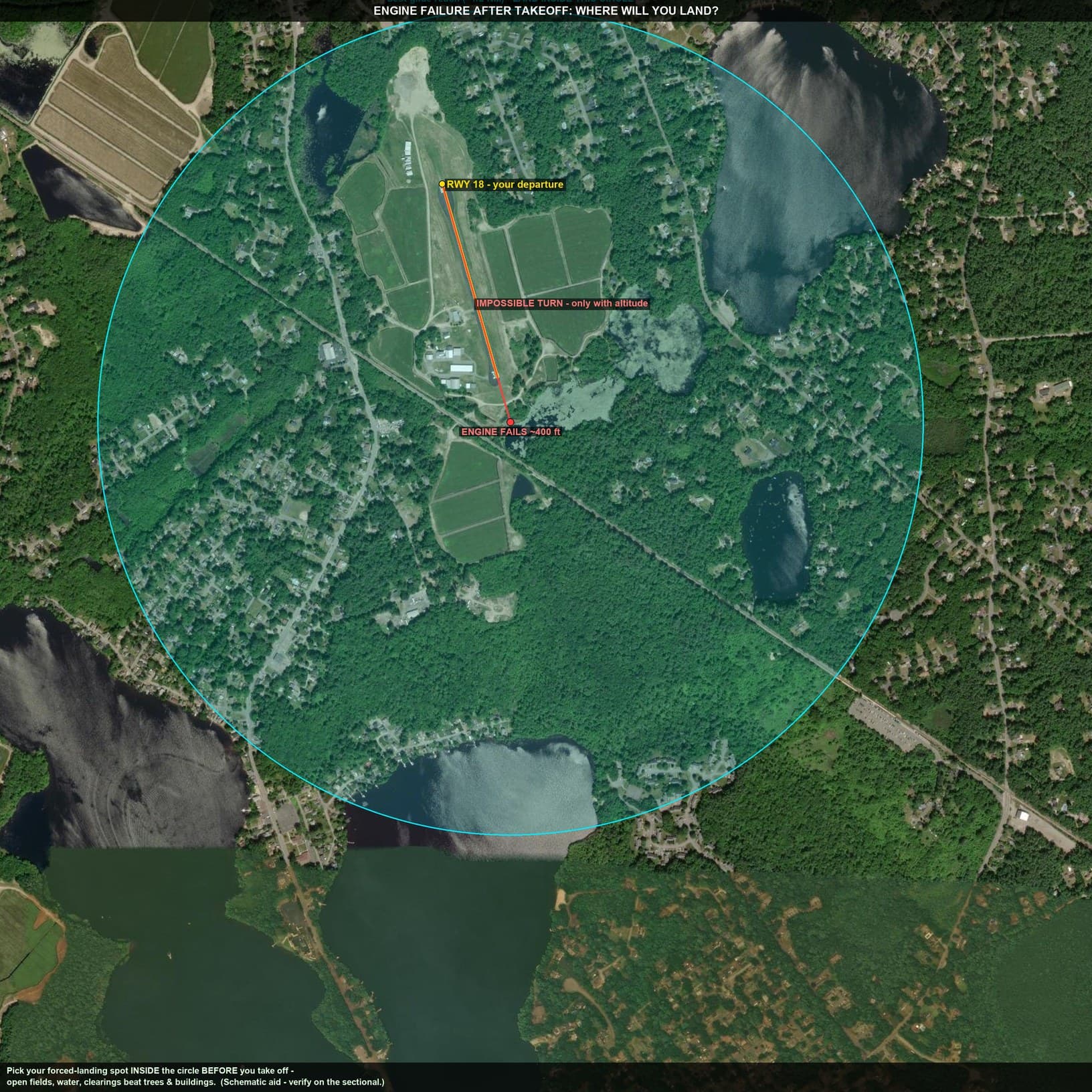
Annotated satellite briefing map for the Impossible Turn mission: runway 18 departure at Cranland Airport with glide-reach circle and engine-failure point marked
The mission briefing map, generated from real imagery: your departure, where the engine fails, and the circle you can actually reach.
In buildNTSB ERA19FA181

The Graveyard Spiral

Northeast Ohio — 1:30 AM, night, no horizon, 4,300 ft

A shallow left bank the pilot never noticed, at night, with no outside reference. The mission drops you into the accident’s exact conditions and asks for the recovery the real flight never made: trust the instruments, level the wings first, arrest the descent, 180 back to visual conditions.

  • Recoverable-scenario form: you start inside the developing emergency, not before it
  • Initial conditions set from the reconstruction — position, altitude, attitude, time of night
  • Briefing built from the investigation’s corrective chain
  • Scenario relocation and control hand-off verified in-sim; teaching content integration is the remaining step

Archetype: spatial disorientation / loss of control in IMC — among the most lethal cells in the matrix

Night, instruments only — in-sim capture coming with the build. No horizon to show you is the point.

Aircraft catalogue

In development

DHC-2 Beaver

The airplane that opened the North — first aircraft in our Marketplace catalogue.

One package, two complete airframes built on the MSFS 2024 SDK with published DHC-2 performance data: the 450 hp R-985 radial, hand-pumped flaps, three belly tanks, and the honest left-turning torque. Float and bush-wheel variants carry separate flight models — contact points, weights, and stability all differ.

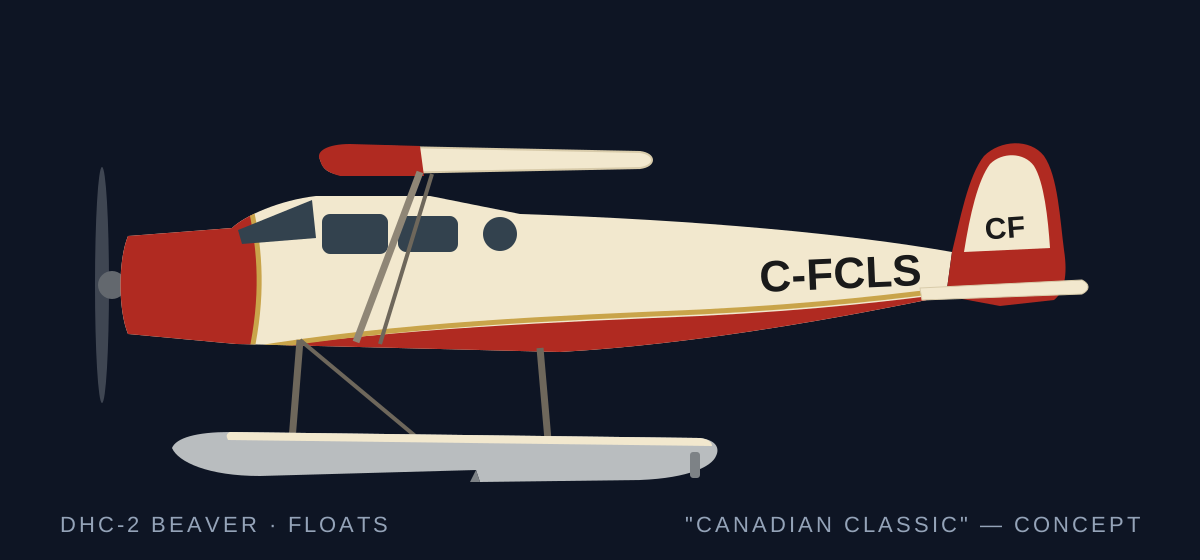
Livery concept sheet: DHC-2 Beaver side profile on floats, cream over signal red with gold pinstripe, registration C-FCLS

Floats — Canadian Classic

Cream over signal red, gold pinstripe, working weathering

EDO floats and water rudders; at home tied to a wooden dock on a glassy lake

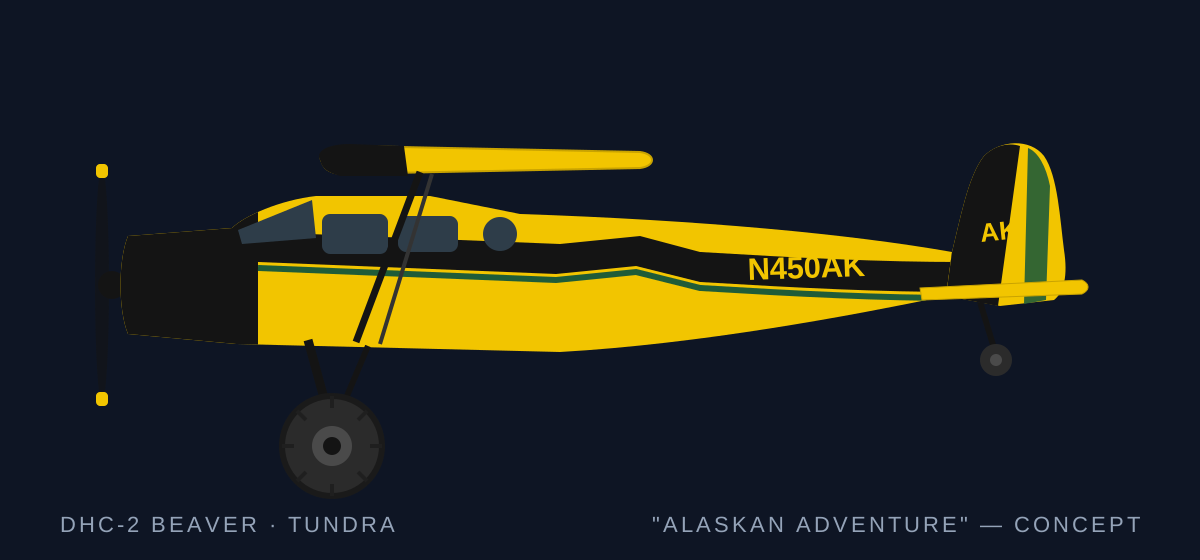
Livery concept sheet: DHC-2 Beaver side profile on tundra tires, bush yellow with black shoulder stripe, green pinstripe, registration N450AK

Tundra — Alaskan Adventure

High-visibility bush yellow, gloss black and forest green accents

29-inch tundra tires and a locking tailwheel; built for gravel bars under snow-capped peaks

Explore the full matrix

All 11 phases of flight against all 5 human-factor typologies — the actual working data behind the mission selection. Every cell carries two different kinds of serious: the redder the hue, the deadlier the situation; the deeper the color, the more often it happens — pale, near-white cells are rare. Select any cell for its accident count, fatality rate, and the most common accident events investigators coded.

More fatal ↑
40%+
10–39%
under 10%
More common →
<100100–599600+
Skl
ADM
Att
Exp
Phy
Standing
Taxi
Takeoff
Climb
Cruise
Maneuvering
Descent
Approach
Landing
Other
Unknown

Maneuvering × Skill / Technique

757 accidents · 386 fatal · 51%

Most common accident events in this cell

  • Maneuvering Loss of control in flight140
  • Maneuvering-low-alt flying Loss of control in flight127
  • Maneuvering-low-alt flying Aerodynamic stall/spin57

Part 91 General Aviation, 2008–202622,045 accidents, 3,906 fatal. The matrix covers the 13,501 accidents whose investigations coded a personal (human-factors) cause; the remainder are mechanical, environmental, or undetermined.

View as table
PhaseSkillADMAttentionExperiencePhysio
Standing88 · 6%82 · 12%36 · 11%4 · 0%
Taxi148 · 1%97 · 1%165 · 1%2 · 0%3 · 33%
Takeoff1,171 · 10%582 · 9%122 · 15%29 · 17%9 · 56%
Climb801 · 39%348 · 37%95 · 65%28 · 46%17 · 88%
Cruise815 · 31%497 · 48%181 · 66%31 · 74%37 · 86%
Maneuvering757 · 51%473 · 53%259 · 51%23 · 65%44 · 89%
Descent44 · 61%23 · 52%6 · 83%2 · 50%1 · 100%
Approach886 · 33%384 · 28%182 · 43%19 · 63%26 · 77%
Landing3,288 · 1%1,375 · 2%148 · 3%15 · 0%12 · 0%
Other67 · 18%51 · 20%9 · 0%3 · 33%2 · 50%
Unknown5 · 0%5 · 0%4 · 75%

Each cell: accidents · fatality rate.

Built by a student pilot with respect for the pilots in these reports. The goal of every mission is the same: the next pilot in that situation makes the other choice.